|
Episcopal Church 101 -- An Introduction ------------- |
|
The Episcopal Church is rooted in Scripture and Tradition. It believes the Holy Scriptures contain "all things necessary for salvation, that Jesus Christ is our Lord and Saviour, and that the Church is the on-going family of faith established by Christ and faithfully passed through the centuries. The Episcopal Church stands on the foundation of Christian witness and the inspiration and leadership of the Holy Spirit thought the centuries. The Church is the means of proclaiming the "Good News" of God's love and the promise of salvation to the world. As such, it is "the same yesterday, today and tomorrow" and is "for all people, in all places and for all times." Sadly, through the centuries the Church has been divided by language, culture, war, and human preference. Therefore we walk in unity desite diversity. Thankfully in modern times unity is being re-estabished as we work closely with sister churches which have held faithfully to the essentials of true doctrine despite variants of liturgy, church structure, and outward appearance. For this we rejoice!
(Q) What does "Episcopal" mean? (A) The word Episcopal comes from the Greek word episcopos which is translated into English as bishop or overseer. Therefore, the Episcopal Church is the "Church governed by a Bishop." The Bishop is effectively the senior pastor of all congregations in a geographic area called a diocese. The Diocese of Alabama is comprised of the northern 2/3rds of the state of Alabama.
(Q) What's with all of the standing, kneeling, and sitting -- the "pew aerobics?" (A) In keeping with the centuries old traditions of the church, "we stand to offer praise, kneel to pray and sit for instruction" although this is not a hard-and-fast rule. What is important is that you are present.
(Q) What's the Book of Common Prayer and why is it important? (A) The Book of Common Prayer or "BCP" is our Book of Worship in the Episcopal Church. The word "common" means --"of the people." Throughout the world various local variants of the Book of Common Prayer are used in the Episcopal/Anglican Church, so wherever you travel you will feel "at home" and the words and order of worship will be familiar.
(Q) I noticed that you don't have Bibles in your pews? (A) Athough some Episcopal parishes have Bibles in the pews, many do not as the very words of our worship service are biblical, Scripture Lessons are read and shared during the Service, and the Sermon focuses on expaining and enhancing our understanding of the Scriptures.
(Q) What translation of the Bible do you use? (A) At Trinity, we normally use the New Revised Standard Version or "NRSV" Bible during worship although the King James Version and other versions are also authoried and used.
(Q) Why are your clergy often called "priests"? Our clergy are pastors, ministers, elders, leaders -- and priests. They pastor us, minister to us, lead and guide us, and lead us in prayer, praise and worship. In addition, in accordance with biblical guidance, they pray to God on our behalf and declare to us God's word. We can always "go to God direct" -- true -- but sometimes we also rely on the help, guidance and knowledge of others who have dedicated their life, study and lobors to God's service.
|
 The Episcopal Church
Welcomes You
The Episcopal Church
Welcomes You
Our Presiding Bishop
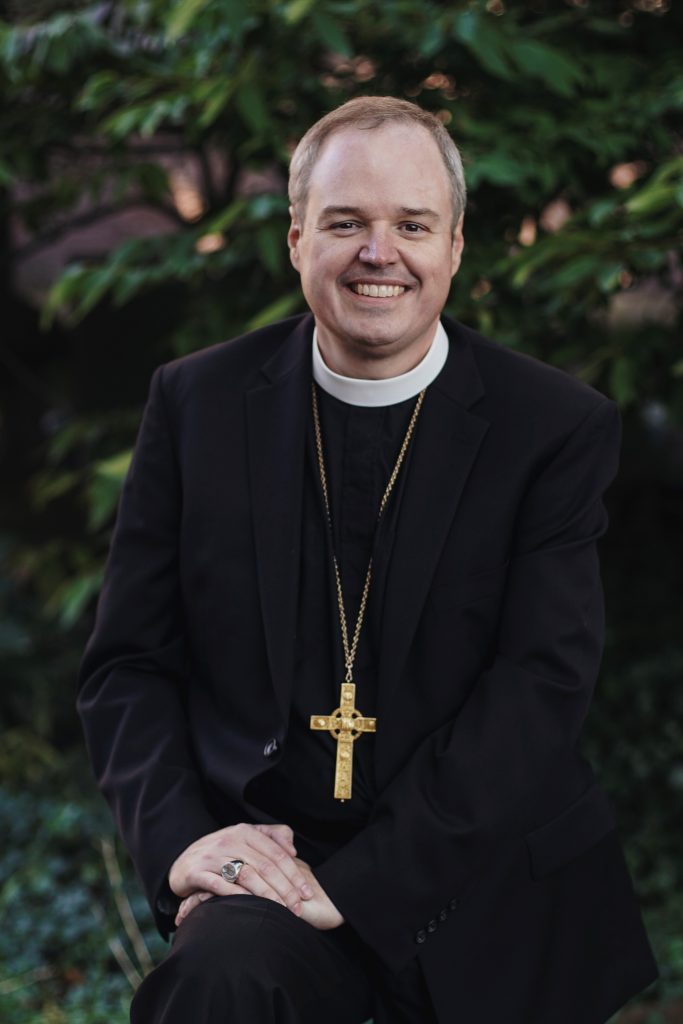
The Most Rev. Sean W. Rowe
28th Presiding Bishop & Primate
The Most Rev. Sean W. Rowe was elected presiding bishop and primate of The Episcopal Church in June 2024 and took office on Nov. 1 for a nine-year term. In this role, he serves as the church’s chief pastor and CEO. Known for his expertise in organizational learning and adaptive change, Rowe is committed to strengthening support for local ministry and mission.
He was ordained bishop of the Episcopal Diocese of Northwestern Pennsylvania in 2007 after serving as rector of St. John’s in Franklin, Pennsylvania, for seven years. From 2014 to 2018, he served as bishop provisional of the Episcopal Diocese of Bethlehem, and from 2019 to 2024, he led a partnership between the Episcopal Dioceses of Northwestern Pennsylvania and Western New York.
Rowe holds a bachelor’s degree in history from Grove City College, a Master of Divinity degree from Virginia Theological Seminary, and a doctorate in organizational learning and leadership from Gannon University. He has served as a leader of many civic and churchwide organizations and governance bodies, and as parliamentarian for the House of Bishops.
Our Family