| TRINITY'S HISTORY |
|
Trinity Episcopal Church was founded in 1834 and is the third oldest church in the Diocese of Alabama. The congregation met in homes and a small log building until 1850 when a frame building was constructed on this lot given by the Lyon family. |
|
Federal Troops burned the framed building during the occupation of Demopolis after the Civil War. The Nave of the present was completed in 1870 from plans drawn up by Edward S. Potter, a New York architect who also designed the chapel at West Point and other famous 19th century church buildings. The transepts were added in the 1890's and the bell tower in 1910. Trinity is one of the finest examples of Victorian Gothic Church architecture in the United States. |
| ITEMS OF SPECIAL INTEREST |
|
|
|
|
|
|
|
|
|
|
|
The Floral Cross window is thought to be a work of Tiffany or one of his proteges. Windows of this type are distinctive for their use of opalescent glass, a technique pioneered by Tiffany. |
| The Melodeon: Trinity purchased the Melodeon in 1834 to provide music for services in homes and the log building. The organ was restored in 1987. |
 The Episcopal Church
Welcomes You
The Episcopal Church
Welcomes You
Our Presiding Bishop
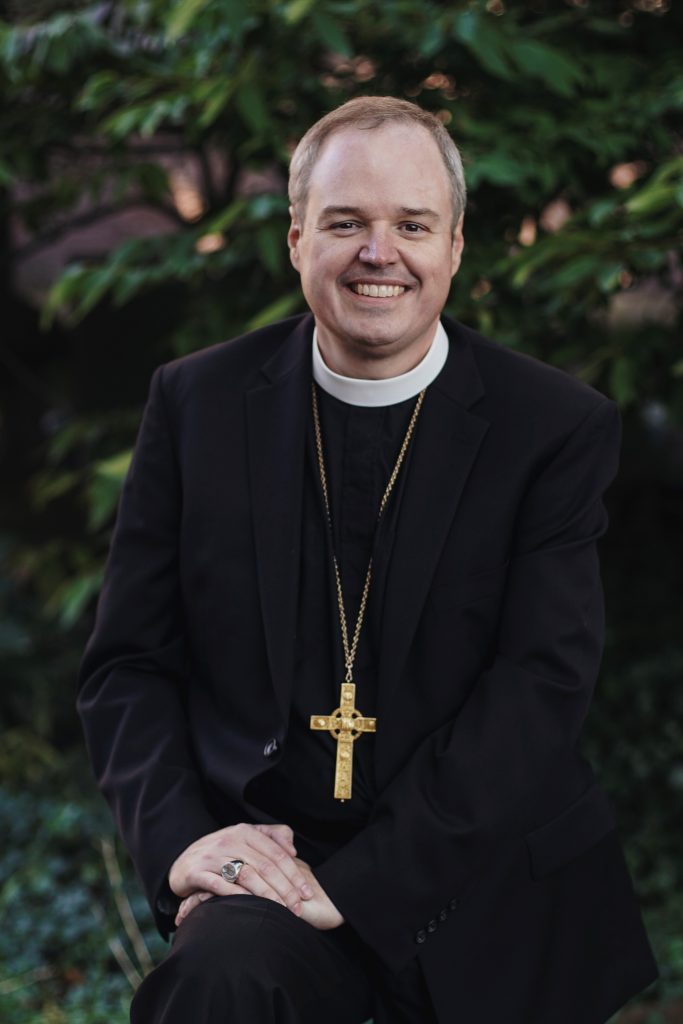
The Most Rev. Sean W. Rowe
28th Presiding Bishop & Primate
The Most Rev. Sean W. Rowe was elected presiding bishop and primate of The Episcopal Church in June 2024 and took office on Nov. 1 for a nine-year term. In this role, he serves as the church’s chief pastor and CEO. Known for his expertise in organizational learning and adaptive change, Rowe is committed to strengthening support for local ministry and mission.
He was ordained bishop of the Episcopal Diocese of Northwestern Pennsylvania in 2007 after serving as rector of St. John’s in Franklin, Pennsylvania, for seven years. From 2014 to 2018, he served as bishop provisional of the Episcopal Diocese of Bethlehem, and from 2019 to 2024, he led a partnership between the Episcopal Dioceses of Northwestern Pennsylvania and Western New York.
Rowe holds a bachelor’s degree in history from Grove City College, a Master of Divinity degree from Virginia Theological Seminary, and a doctorate in organizational learning and leadership from Gannon University. He has served as a leader of many civic and churchwide organizations and governance bodies, and as parliamentarian for the House of Bishops.
Our Family